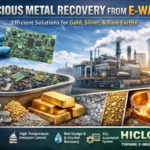
Precious Metal Recovery from E-Waste: Advanced Thermal Pre-Treatment Strategies for a Resource-Constrained World
1. E-Waste as a Strategic Metal Resource
The global transition toward electrification, digitalization, and artificial intelligence has sharply increased demand for gold, silver, platinum-group metals, copper, and rare earth elements. Smartphones, servers, EV power electronics, telecom infrastructure, and industrial automation equipment all rely on metal-intensive components. At the same time, traditional mining faces rising costs, declining ore grades, environmental opposition, and geopolitical concentration.
Against this background, electronic waste recycling―often described as urban mining―has moved from an environmental obligation to a strategic industrial sector. Printed circuit boards (PCBs), connectors, chips, relays, and coated components frequently contain metal concentrations far exceeding those of primary ores. Efficient recovery, however, depends on precise and well-controlled processing routes.
2. Why Thermal Pre-Treatment Is Critical in Precious Metal Recycling
Most e-waste streams are complex composites of metals, polymers, resins, oils, coatings, and additives. Direct chemical leaching or smelting without preparation leads to:


-
Low metal recovery efficiency
-
Excessive reagent consumption
-
Unstable reactions caused by residual organics
-
High emissions of oil smoke, VOCs, and acid gases
-
Loss of precious metals in fly ash or uncontrolled residues
A controlled thermal pre-treatment stage solves these issues by selectively removing organics while preserving metal content in a recoverable form.
3. The HICLOVER Thermal Concept for E-Waste and Precious Metals
The HICLOVER Precious Metal Recovery Furnace is designed as a process tool, not a disposal incinerator. Its role is to convert metal-bearing e-waste and industrial residues into high-grade ash and concentrated intermediates, ready for downstream hydrometallurgical or pyrometallurgical recovery.
Typical feed materials include:
-
PCB scrap and shredded electronics
-
Precious-metal-loaded resins and activated carbon
-
Plastic-coated connectors and cables
-
Oily sludges, coatings, and contaminated filters
-
Laboratory and pilot-scale recycling residues
4. A/B/C Process Architecture: Controlled, Clean, and Recoverable
Stage A C Controlled Low-Temperature Roasting / Ashing
At this stage, organic components are gradually decomposed under controlled conditions. Unlike open burning or uncontrolled incineration, temperature rise and airflow are carefully managed.
-
Plastics, resins, and oils are removed without violent combustion
-
Metals remain concentrated in dry, stable ash
-
Ash is collected using movable high-temperature trays
-
Centralized ash handling improves mass balance and traceability
This approach minimizes metal loss and avoids oxidation or dispersion of gold, silver, and PGMs.
Stage B C High-Temperature Afterburner
All oil smoke, VOCs, and pyrolysis gases released during roasting are routed to a dedicated afterburner.
-
Complete oxidation of hydrocarbons and odors
-
No black smoke or sticky tar formation
-
Reduced fouling of ducts and downstream equipment
-
Stable operation under continuous or batch modes
This stage is essential for environmental compliance and long-term reliability.
Optional Stage C C Quench Spray Scrubber
For projects with stricter emission limits or oil-rich feedstocks, a quench scrubber can be integrated.
-
Rapid gas cooling and washing
-
Capture of fine particulates and acid components
-
Demisting before stack discharge
-
Generation of wet sludge, which can be periodically removed and re-ashed to recover residual metals
The result is a closed-loop recovery logic with minimal loss of valuable material.
5. Key Technical Advantages for Recycling Operations
-
Dual recovery streams: dry ash + wet sludge
-
Higher precious metal retention compared to uncontrolled burning
-
PLC recipe control of temperature profiles, holding time, airflow, and safety interlocks
-
Customizable chamber volume and throughput capacity
-
Fuel flexibility: Diesel, Natural Gas, or LPG
-
Modular design with optional containerized or mobile deployment
This flexibility allows recyclers to scale from pilot plants to industrial lines without redesigning the entire process.
6. Relevance to Current Hot Topics: Rare Earths and Supply Security
Beyond gold and silver, modern electronics contain rare earth elements and specialty metals critical for permanent magnets, sensors, and energy-efficient motors. Governments and industrial groups increasingly promote localized recycling infrastructure to reduce dependence on volatile mining regions.
Thermal pre-treatment systems like the HICLOVER solution support these strategies by:
-
Enabling cleaner separation before chemical refining
-
Reducing secondary pollution risks
-
Supporting ESG and circular-economy targets
-
Allowing deployment near urban collection centers or industrial zones
7. Typical Application Scenarios
-
E-waste recycling plants processing mixed electronics
-
Precious metal recovery workshops and refineries
-
Battery and electronics R&D laboratories
-
Industrial waste treatment centers handling metal-bearing residues
-
Emerging markets building domestic recycling capacity
8. Conclusion: Turning Complex Waste into Recoverable Value
As precious metals and rare earths become increasingly strategic, controlled thermal pre-treatment is a cornerstone of modern e-waste recycling. By combining low-temperature roasting, high-temperature afterburning, and optional wet scrubbing under PLC control, HICLOVER systems provide recyclers with a clean, efficient, and value-preserving pathway.
For organizations seeking higher recovery rates, regulatory compliance, and scalable deployment, this approach transforms electronic waste from an environmental burden into a reliable secondary resource stream―aligned with both industrial performance and long-term sustainability goals.